An Economy Exporting youth And importing growth

Have you ever heard of a country exporting goods and services?
The answer is Yes.
But have you ever heard of a nation exporting its own people?
It may sound harsh—even brutal—but it is a reality. Several countries, including India, China, Vietnam, and the Philippines, rely on exporting labor as a key part of their economy. Among them, Nepal stands out, with nearly 75% of its workforce engaged in foreign employment.
However, the real concern is not just the volume, but the quality of this export. In countries like India, around 80% of migrant workers are highly skilled. In contrast, Nepal’s situation is quite different—about 74% of its labor force abroad is unskilled, while only around 1% is highly skilled. Nepal has become a nation that exports its most vital resources which is youth to import the growth. Nepal’s economy is increasingly being saved not by what it produces, but by where it is people work. As of early 2026 youth migration in Nepal, has reached record breaking levels, shifting from a supplemental labor strategy to a defining demographic exodus. As such approximately 2300+ Nepali people leave Nepal daily for foreign job. Top destinations are UAE, Saudi Arabia, Qatar, Malaysia, and Kuwait.
While migration is a natural phenomenon and people migrate in search of opportunities. It depends on people’s choice, but the situation becomes worse when the migration becomes a COMPULSION. This is the situation of Nepal where people are compelled to leave their hometown and family behind, in search of good Fortune. Recent surge in migration is particularly due to the complete system failure because of political indiscipline, lack of job assurance, frustration, etc. Leaving behind the dependent group children and old aged people group who cannot contribute much to the country.
While this massive departure of young talents and resources creates a daunting Brain Drain and Brawn Drain domestically, it simultaneously provides the fuel to keep the national economy afloat. This is an irony but a reality that 2300 youths leaving the nation daily are the export that generates about 1.917 trillion remittances (growth). This is 41.2% increase in remittance as compared to the same period last year. Remittance is becoming a major contributor to our national economy. Despite huge contribution, Nepal has not been able to utilize it effectively. NLSS IV (202223) shows that 75% to 80 % of these incomes are used for household consumption, 10% to 15% for debt repayment and education and only nominal percentage of approx. 2% to 5% is used for productive investments.
Remittance has undoubtedly been a major driver in reducing poverty and stabilizing the economy. However, the relationship between youth migration and large remittance inflows remain somewhat contradictory, as this trend has contributed to a widening trade deficit, particularly given that Nepal is a consumption driven trade dependent economy with limited self-reliance. NRB Macroeconomic Report July 2026 shows a strengthening external sector alongside persistent trade imbalance.
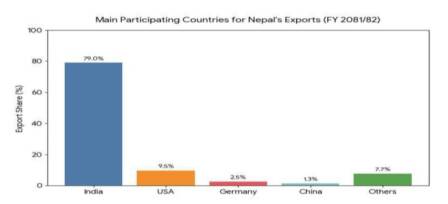
Despite increase in export, the massive volume of import led to substantial merchandise trade deficit. Nepal traded with 169 countries in 20242025. But it faces a chronic and massive trade imbalance. It runs a deficit with majority of its partners. India and china are the two major trade partners of Nepal. Trade deficit stands at Rs. 1443 billion . Nepal recorded trade deficit with 133 countries and surplus with 36 countries. Despite the huge trade gap, remittances inflow has exceeded the huge trade deficit, serving as a critical economic lifeline for a Nation.
Nepal’s Gross Domestic Product (GDP) currently stands at around $45 billion. On paper, this growth looks like progress, but we have to ask ourselves where this money is actually coming from. A massive part of this growth is not coming from factories or large-scale exports, but is being supported by the money sent home by our youth. Essentially, our GDP is growing because our people are working elsewhere.
Though Nepalese economy looks picture perfect. This perfection is bought on the cost of Nepalese youth. This stability is built on a foundation of borrowed time. The mechanism is efficient but uncertain.

As long as remittances inflow is greater than trade deficit the BOP remains in surplus. But this cycle is based on the assumption of constant outflow of youth and stable global environment, which almost is impossible. Experts warn that if the war in the Middle East lasts a long time, the money sent home by workers could drop by half, and we might see a massive increase in the number of returning migrants. So, Is Nepal ready for the “Reverse Flow Scenario?
Because of a mass return of millions of Nepali currently abroad, the impact would be unfortunate for following reason:
1. Economic Shock:
Liquidity Trap: Remittance currently serves 33% of GDP. A sudden stop or rapid decline would instantly dry up the cash flow resulting in increment of poverty.
Foreign exchange collapse: Remittance provide 50% of Nepal total foreign exchange. Without it the reserve would soon deplete as Nepal continue to import fuel and food leading to BOP crisis and currency devaluation.
Inflation rise: If remittances suddenly drop because of a crisis in the Middle East, Nepal will face a shortage of US Dollars needed to buy goods from other countries. When these dollars become scarce, the Nepali Rupee loses its value, making everything we import—from petrol to rice—much more expensive at the border. This is called “imported inflation”. Experts warns that there will be at least a 2-percentage-point rise in inflation because our local farms and factories cannot produce enough to meet the sudden demand of returning millions.
Banking sector vulnerability: The immediate halt in remittance inflow would not only create liquidity pressure in banking sector but also significantly increase NPA, as many migrants in loss of their job and income would be unable to repay loans that they had taken before going abroad.
2. Labor market: An unabsorbable workforce:
Job inadequacy: The domestic market is already struggling to create new jobs as a result of which 2300 people are migrating daily. Absorbing a large number of returnees at once is statistically impossible in the current scenario.
Skill mismatch: While some may return with some added skill but majority of them work in Gulf countries and are unskilled. And their skills often do not match the specific needs of Nepal’s limited industrial sector.
3. Social and Psychological Crisis:
The stigma of failure: Migrants are often expected to return with significant wealth. Those forced back by crisis are frequently viewed as economic failures and could face community discrimination, which could lead to social isolation.
Mental Epidemic: Studies of returnees in 2025 show an alarming rate of anxiety(56%) and depression (23%).
GLIMPSE OF HOPE (THE ALTERNATIVE)
Despite the risk, it could be a revitalizing opportunity if managed properly.
Agriculture Revival: Roughly 60% of returnees express interest in moving back into agriculture. This could potentially reverse the trend of abandoned farmland if the government brings favorable policy to provide land, technology, and market linkage.
Entrepreneurship: About 63% of returning migrants show an interest in starting their own small businesses or family Enterprises.
Skill and Technology Transfer: Migrants return back with new skills and knowledge. They often bring back a working culture of discipline and efficiency.
Social Change: They bring back social remittance, new ideas about democracy, gender equality, and government accountability, which can drive long-term social progress.
GOVERNMENT ACTION TILL DATA:
A) Remi Project (2022-2026): This bilateral project with Switzerland is currently providing reintegration services in 20 local levels. It is scheduled to scale up to all 753 local levels after July 2026. Now currently, this project is implemented across Koshi Province and Madhes Province.
- Institutional Set Up: The project has successfully established reintegration help desks in 20 municipalities. Returnees can walk in, register their skills, and get immediate counseling.
- Funding: Funding is provided by the Swiss Agency for Development and Cooperation, with a budget of around 1 billion for the first phase.
B) Start-Up Business Loan: To retain youth and reintegrate returning migrants, the government has announced a startup business loan from NPR 5 to 20 Lakh with a minimal interest rate of 3% and a payback period of up to five years. This facility is provided through the Ministry Of Industry, Commerce and Supplies. Currently, this loan is in practice and actively provided through Rastriya Banijya Bank on the recommendation of the Industrial Enterprise Development Institute (IEDI). Already, thousands of proposals have been registered, which shows the Nepali youth’s interest in staying in Nepal.
C) Employment Service Center: Employment service centers are being set up in every municipality as first entry points for returnees to get counseling, training, and help with soft loans.
D) Directives for Reintegration: The government recently approved new directives to utilize returnees’ capital and technology for social and economic development.
WAY FORWARD
Nepal is graduating from least developed country status to developing country status, with which Nepal will lose many international trade concessions. So, the government must instantly focus on quality standardization and international certification for Nepali products to ensure competitiveness in the global market.
Furthermore, to be self dependent, the government must move from importing stability to building productivity. Every rupee from remittance must be incentivized to flow into productive investment rather than just daily consumption. The government should formulate policies and programs aimed at retaining youth within the country.
1. Economic Reengineering:
- Redirect Remittance into Equity: The government should instantly launch a Remittance to Project Bond or Equity Fund. This would allow migrants to directly own shares in the national structure.
- Mandatory Social Sourcing for Public Projects: The government should instantly mandate that a certain percentage of materials for large scale national pride projects must be produced domestically. This creates an immediate guaranteed market for local cement, steel, and furniture industries.
- Digital Export Fast Track: It is a policy framework designed to turn Nepal’s “Brain Drain” into a “Digital Gain.” It treats the internet as a borderless highway, allowing young Nepalis to export their skills (software, AI, design) globally while living physically in Nepal. For any IT startup registered in Nepal with an annual turnover of up to Rs. 100 million (10 Crore), the
government provides a 100% income tax exemption for the first five years.
2. Fixing the Trade Deficit:
- Modernize Agriculture Via Contract Farming: This involves connecting youth farmers to large retailers with a buyback agreement at a minimum support price, ensuring they don’t lose money if the market price drops.
- Energy as Currency: Accelerate the export of electricity to India and Bangladesh. Simultaneously, the government should instantly provide subsidies for electric cooking and EV’s to reduce the massive import cost of petroleum.
- Incentivize Assembling Industries: Rather than importing finished goods, provide land and tax breaks for companies to set up assembling plants within Nepal, creating true-color jobs for those who otherwise go to the Gulf.
3. Retention through Dignity of Labor:
- Certification of Skills: Instantly launch a national program to formally certify the skills of returning immigrants. A person who worked as a certified electrician in Dubai should be automatically licensed to work on government projects.
- Streamline start-up loans: Rs 2.5 million start-up loan must be moved from the proposal waste system to a proof-of concept system where the government looks for a working model of a prototype or evidence that the idea actually works in the real world. The project should be approved within a 30-day deadline to prevent youth from losing patience and leaving again because of the government being stuck in the selection process.
- Social Security for Al: Fully Security for private sector workers. The fear of unsecure future is a major driver of migration.
While the government provides the policy framework for this economic transformation, the banking sector serves as the vital engine required to mobilize capital and turn these strategic visions into a productive reality.
Opportunities for Banking Industries:
Capitalizing on Digital Exports: With the proposed “Digital Export Fast Track” and tax exemptions for IT startups, banks can develop specialized “Freelancer Accounts” and international payment gateways to capture foreign currency earnings from the digital economy.
Financing Returnee Entrepreneurship: Banks have a massive opportunity to grow their loan portfolios by moving from collateral-based lending to a “Proof of Concept” system for startup loans. This can specifically target the 63% of returning migrants interested in starting small businesses.
Remittance-Linked Investment Products: Instead of allowing 80% of remittances to be spent on consumption, banks can launch “Remittance Project Bonds”. This allows banks to manage large-scale investment funds for national infrastructure projects, backed by the steady flow of migrant capital.
Modernizing Agricultural Credit: As 60% of returnees wish to return to farming, banks can partner with the government to provide “Coimntract Farming Loans”, ensuring a secure lending environment by linking loans to guaranteed buyback agreements.
Managing Social Security Funds: As the government fully implements contribution-based Social Security for the private sector, banks will have the opportunity to manage these massive liquidity pools, providing long-term investment capital for the economy.
Green Financing: With the shift toward “Energy as Currency” and subsidies for EVs, banks can lead the market in “Green Auto Loans” and renewable energy financing, helping to reduce the trade deficit.
Conclusion
The current stability of Nepal’s economy is a paradox. Country is financially liquid precisely because it is poor in human capital. As long as the remittance inflow covers the trade deficit, the gears of the economy will continue to run. However, this mechanism assumes a world without geopolitical shock.
Nevertheless, there is a positive side to returning migrants. And to survive the “Reverse Flow Scenario”, Nepal must shift from “importing stability to building productivity”. By incentivizing the 2% to 5% of remittance currently used for investment and redirecting it into domestic production, agriculture, and digital exports, the nation can transform a “Brain Drain” into a “Digital Gain”. The goal is to ensure that the next generation of Nepalese stays—not because they are compelled to, but because they have the dignity of labor and the assurance of a secure future at home.
References
Department of Customs (DoC). (2026).Foreign Trade Statistics: Fiscal Year 20252026 (Mid-Year Review). Government of Nepal.Link: https:www.customs.gov.np
Department of Foreign Employment (DoFE). (2026). Labor Migration Trends and Permit Issuance Report. Ministry of Labour, Employment and Social Security.
Industrial Enterprise Development Institute (IEDI). (2025). Guidelines for Start-up Business Loan and Reintegration Support. Link: http:www.iedi.org.np
National Statistics Office (NSO). (2024). Nepal Living Standards Survey IV (NLSS IV) 202223: Consumption and Remittance Utilization Report. Link: https:nso.gov.np
Ministry of Finance (MoF). (2026). Nepal Economic Survey 208283. Government of Nepal.
Economic Research Department, Nepal Rastra Bank (NRB). (2026). Macroeconomic Report: Analysis and Outlook (July 2026). Central Bank of Nepal. https:www.nrb.org.npcontent suploads202607Macroeconomic_ Report_July_2026.pdf.