Nepal’s LDC Graduation: Implications, Prospects and Way Forward

Introduction
Countries that experience socio-economic vulnerability, underdeveloped human capital, and heightened exposure to economic shocks are classified as Least Developed Countries (LDCs). Nepal was listed as an LDC by the United Nations in 1971, among the initial 44 LDCs. With Nepal’s LDC graduation scheduled for November 2026, multiple perspectives—both supportive and critical—are emerging. Graduation represents a significant step toward national dignity and self reliance; however, it is crucial to carefully assess the potential challenges and develop strategies to manage them effectively.
Thresholds for LDC Graduation
The UN Committee for Development Policy (CDP) conducts a triennial review every three years based on three parameters:
- GNI per Capita: USD 1,306 or above.
- Human Assets Index (HAI): ≥ 66.
- Economic and Environmental Vulnerability Index (EVI): ≤ 32.
| Indicators | Triennial Review 2018 | Triennial Review 2021 | Triennial Review 2024 |
|---|---|---|---|
| Status | First time eligible | Confirmed eligibility | Post-eligibility monitoring |
| Criterial Met | HAI+EVI | HAI+EVI | Already met (no re-valuation) |
| GNI per capita | Below threshold | Improving but still weak | Gradual improvement |
| UN Decision | Listed as eligible | Recommended for graduation | Graduation on track |
| Graduation date | Not fixed | Initially 2024 | Postponed to 2026 November |
Nepal’s Preparations for Graduation
Nepal has met two of the three indicators required for LDC graduation and is preparing for the November 2026 milestone. To ensure a smooth transition, the National Planning Commission (NPC) introduced the Nepal LDC Graduation Smooth Transition Strategy (STS) in 2024. The STS is fully integrated into the 16th Periodic Plan (FY 2081/82–2085/86) and Nepal’s Integrated Trade Strategy2080. It aims to mitigate the loss of international support measures while capitalizing on new economic opportunities.
Major Impacts and Challenges
The STS provides sector-specific evaluations of domestic and external vulnerabilities, enabling the formulation of adaptive post-graduation policies. Key considerations include:
- Export Risks: A projected 4.3% decline in exports due to the loss of LDC-specific preferential market access.
- Aid and Financing: Total Official Development Assistance (ODA) may not fall significantly, but borrowing costs could
increase as concessional terms shift with Nepal’s rising income. - Policy Space: Certain flexibilities under WTO agreements, including extended transition periods for intellectual property (TRIPS) and pharmaceutical patents, will be reduced.
Six Strategic Pillars of the STS
The strategy is anchored on six pillars with defined objectives and timelines:
- Macroeconomic Stability & Fiscal Sustainability: Strengthen the economic base and ensure sound financial management.
- Trade and Investment: Negotiate bilateral and regional agreements to offset the loss of LDC-specific duty-free and quota-free access.
- Economic Transformation: Promote structural shifts from agriculture and remittance dependence to high-growth sectors such as IT, hydropower, and tourism.
- Building Productive Capacity: Enhance workforce skills and expand human capital for global competitiveness.
- Climate Change & Disaster Risk Management: Integrate adaptive strategies to address environmental vulnerabilities.
- Social Inclusion & Integration: Ensure that the benefits of graduation reach marginalized groups and reduce regional disparities.
Post-Graduation Pathways
Following LDC graduation in November 2026, Nepal will transition from “preferential treatment” to “competitive diplomacy.” In FY 2081/82, Nepal’s exports totaled Rs. 277 billion, dominated by India (79%) with key exports including refined edible oils (soybean and palm), electricity, and large cardamom. The USA accounted for 9.5% of exports, mainly high-value traditional goods such as knotted woolen carpets and felt products, while China contributed only 1.3%.
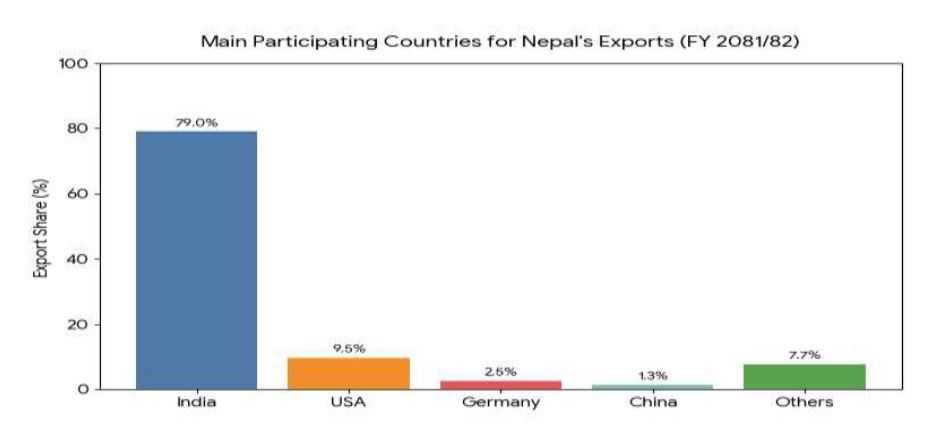
Since Nepal’s trade is heavily concentrated with India, any post graduation export contraction is likely to originate from this market. Policymakers must assess potential losses and implement mitigation strategies.
1. Specific Trade Agreements & Market Access
Since Nepal will lose Duty-Free Quota-Free (DFQF) access in many markets (like the EU’s “Everything But Arms” scheme), the government is pursuing several alternatives:
- GSP+ Status: Nepal is preparing to apply for the EU’s GSP+ scheme. This provides similar duty-free access but requires ratifying and implementing 27 international conventions on human rights, labor, and environment.
- Bilateral Free Trade Agreements (FTAs): The Ministry of Commerce is prioritizing FTAs with major trading partners like China, India, Bangladesh, and the USA to secure preferential rates for Nepali exports (textiles, carpets, and medicinal herbs).
- Regional Integration: Strengthening ties within BIMSTEC, SAFTA, BBIN to boost intra-regional trade, focusing on reducing non-tariff barriers (like quarantine and laboratory testing issues).
- TRIPS Flexibility: Nepal is negotiating for an extended transition period regarding Intellectual Property Rights,
particularly to protect its local pharmaceutical industry from high patent costs immediately after graduation.
2. Financial Support & Development Assistance
While Nepal’s income is rising, the “cost of money” will likely increase. The strategy to manage this includes:
- Blended Finance: Moving away from pure grants toward a mix of grants and concessional loans. The 16th Plan emphasizes mobilizing Public, Private and Cooperative investment on the proportion 30.2%,67.2% and 2.6% respectively to fill the investment gap of Rs 111.84 Kharba.
- Climate Finance: Nepal is positioning itself to access global funds like the Green.
- Climate Fund (GCF). Since these funds are based on environmental vulnerability rather than LDC status, Nepal remains a prime candidate.
- Multilateral Support: Partners like the World Bank and ADB have committed to “transitional support,” meaning they won’t cut funding immediately but will shift focus toward infrastructure and energy projects that generate revenue.
- Technical Assistance: The UN and other agencies are providing “soft support” to help Nepali bureaucrats handle complex international trade litigation and compliance standards.
3. The “Export Gap”Challenges
Estimates suggest a potential 4% to 11% drop in exports post-2026 due to higher tariffs. To counter this, the 16th Plan focuses on:
- Lowering Cost of Production: Improving electricity reliability and reducing transport costs through better roads and dry ports.
- Branding: Promoting “Made in Nepal” and “Collective Trademarks” for high-value products like Himalayan water, Orthodox tea, and pashmina.
- Priority Export Products: To mitigate the loss of LDC-specific trade preferences, the 16th Plan and the Smooth
Transition Strategy (STS) prioritize a specific list of high-value, low-volume products. These are categorized under
the Nepal Trade Integration Strate gy (NTIS) 2023, focusing on sectors where Nepal has a competitive advantage. The NTIS 2023 significantly expanded the list of priority export products and services from 12 (in 2016) to 32, aiming to invigorate Micro, Small, and Medium Enterprises (MSMEs).
| Category | Specific Products | Target Markets |
|---|---|---|
| Agro-Based | Cardmom (Large), Orthodox Tea, Ginger, Turmeric, Coffee, and Himalayn Honey. | India, UAE, EU, USA, Japan |
| High-Value Crafts | Chyangra Pashmina, Handmade Paper (Lokta), Felt Products, and Carpets. | USA, Germany, UK, France. |
| Natural Resources | Medicinal and Aromatic Plants (MAPs), Rosin and Turpentine, and Himalayan Spring Water. | India, China, EU. |
| Footware | Leather and Synthetic Footwear. | India, Bhutan. |
4. Strategic “Service” Exports
Since goods face high transport costs (Nepal being landlocked), the 16th Plan shifts heavy focus toward service exports, which aren’t affected by physical borders or LDC graduation tariffs:
- IT & Business Process Outsourcing (BPO): Software development, data analytics, and digital services (aiming for Rs 3 trillion in exports).
- Clean Energy: Exporting surplus Hydropower to India and Bangladesh (targeting 10,000+ MW production).
- High-End Tourism: Specialized trekking, wellness/yoga retreats, and cultural circuits.
5. Structural Reforms for Post LDC Survival
The strategy introduces several “structural shifts” to ensure Nepal remains competitive without LDC specific duty-free access:
- Digital Trade & 4IR: Prioritizes E-commerce (B2B, B2C) and the use of 4th and 5th Generation industry concepts.It proposes a National Payment Gateway and a National Digital Depository to facilitate digital transactions.
- Trade Infrastructure: Focuses on up grading testing labs and plant quarantine facilities in Kathmandu and Birgunj to meet Sanitary and Phytosanitary (SPS) standards, reducing reliance on third-country testing.
- Decentralized Implementation: Encourages provincial and local governments to identify and promote products
unique to their regions (e.g., direct exports from Madhesh province to neighboring Indian states). - New Institutions: Recommends establishing a Service Trade Promotion Institute and a Market Intelligence Section within the Ministry of Industry to analyze global demand.
- Collective Trademarks: Registering brands like “Nepal Tea: Quality from the Himalayas” and”Chyangra Pashmina” innternational markets to command premium prices.
Quality Certification: Establishing internationally accredited labs in Nepal so exporters don’t have to send samples to India or Thailand for testing.
Conclusion and Recommendations
LDC graduation is both an opportunity and a challenge for Nepal, it signifies international recognition but requires careful transition management, policy reforms, and strategic planning to ensure sustainable development beyond 2026. STS and 16th Periodic Plan offer frameworks for stabilizing macroeconomics conditions, accelerating sectoral diversification and fostering
equitable growth. With the formation of a new government, there is hope for political stability and economic transformation.
Nepal must now focus on building a selfreliant economy that leverages post-LDC graduation opportunities, addresses potential challenges, and expands export-oriented trade through internal stability and structural reforms.
References
NPC: Smooth Transition Strategy for LDC Graduation-2024, National Planning Commission of Nepal.
https://npc.gov.np/
h t t p s : / / n p c . g o v . np/content/6783/sixteenth-plan-implementation-action-plan–fiscal-year/