Growing Importance of Embedded Finance in Today’s Banking Era

Background
Embedded Finance can be understood as the process of having seamless integration of financial services like payments, lending, insurance, and investments directly into non-bank platforms like e-commerce apps, retail stores, or even ride-sharing services or social media-based channels. For a long time, financial services were operated as a distinct and centralized industry with traditional domination of banks, insurers, and investment firms. Such institutions intend to provide basic services like payments, credit, savings, and risk management with the help of physical branches and through highly regulated systems. This integration of their internet technologies, cloud computing, and mobile-based devices worked to enable financial services, allowing them to be more agile, efficient, and accessible. Unlike traditional models in which users should access different financial institution to perform financial activities, the whole concept of embedded finance focuses on allowing them to do in direct form within the digital environment that they have been using on normal basis – like customer can apply for a loan through the same mobile app and also pay for a ride through same app without any requirement for making visit to the bank. They should not open a separate application either, but all the tasks can be done through the same platform. As stated by Sahay et al (2015), the rise of embedded finance does not just increase financial access but also works to simplify user-based experiences, reducing transaction times and strengthening their own financial inclusions.
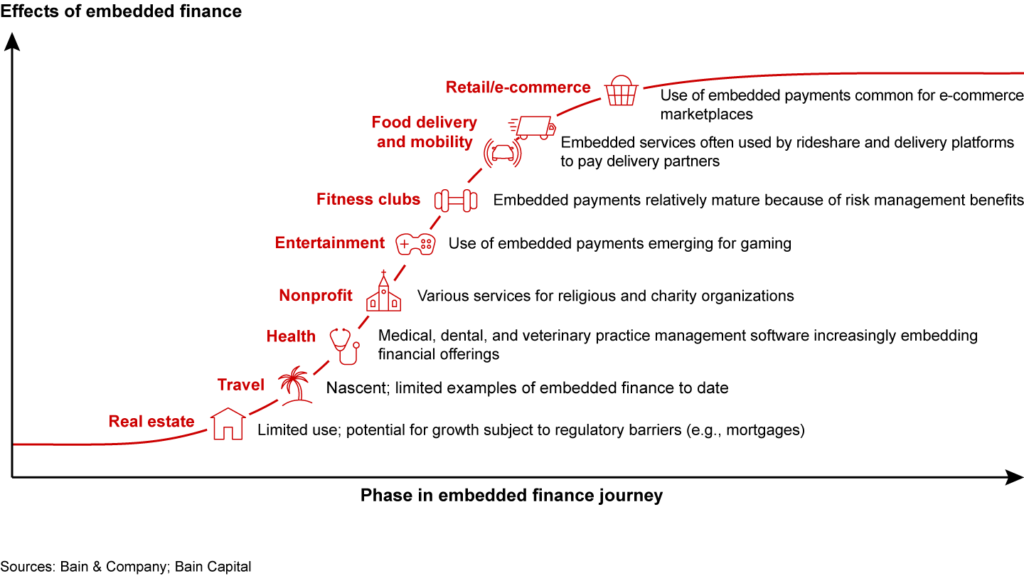
The figure shows how different industries are positioned with embedded financial journeys, how far they have progressed, and the impact that embedded finance has on them. Retail and e-commerce are at the most advanced stage here; however, there is a rise in other approaches as well. The whole potential for future growth looks in areas such as booking, rental, and mortgages, which also create an impact here.
Embedded finance has also been explained as the process of separating financial services from classical bank channels and their integration into non-bank digital platforms, where the user unwittingly makes use of banking services while making a payment on a shopping website, and where buying insurance from a mobile application or sending money through a social media application can be done with ease.
Traditional Banking and Embedded Finance
Traditional banking follows a bank-centric model in which customers should visit branches, make use of ATMs, or access bank-owned digital platforms for performing financial transactions. For service payments like, loans, remittances, and insurance are available through a separate platform or space. They generally involve paper-based work with manual verification and longer processing times, and customers get to experience a large portion of the physical infrastructure that comes with it. There lie stronger branch networks and formal procedures that come along with them. This model limits accessibility for people in rural areas, involves gig-based workers and small merchants who find the whole process difficult for meeting the basic documentation or even collateral requirements. So, in Nepal, traditional practice works to dominate basic activities like loan approvals, EMI processing, and even remittance collection, where customers should interact directly with banks or authorized counters.
Whereas in the context of embedded finance, there lies integration of financial service directly into non-banking platforms like e-commerce spaces, ride-sharing services, or food delivery apps, along with digital wallets. This makes banking almost invisible, and customers can pay, borrow, or save, ensuring that they can all come within the apps which they already use without switching into a banking interface, creating a seamless, fast, and convenient digital experience. This also works to expand financial access, accelerating digital adoption, allowing banks to become API driven enablers behind the whole scenes allowing banks to become API driven enablers working behind the scenes rather than a sole touchpoint for customers.
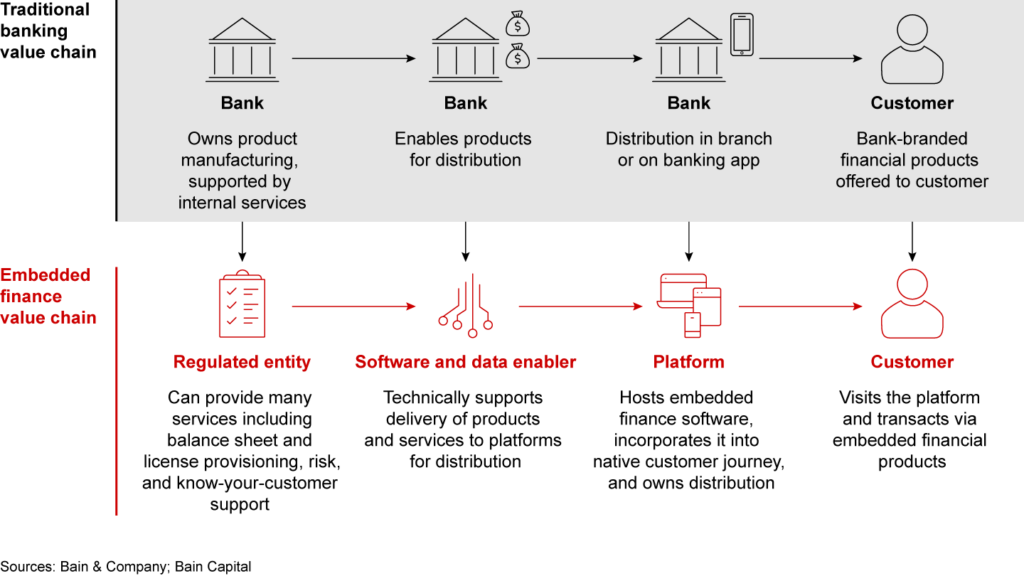
The figure shows how the delivery of financial services shifts from a bank-centered model to a platform-centered model, embedding a financial model. The traditional value chain is the space where a single bank manufactures financial products and works to manage internal processes like risk and compliance, whereas the embedded financial value chain breaks into the process, showing three separate roles with a regulated entity.
Forms of Embedded Finance
Embedded Finance could appear in multiple forms on the basis of the type of financial services being integrated into non-banking platforms. The different forms of embedded payments are:
- Embedded Payments: This means that payments take place inside non-banking platforms without switching apps. Embedded payments make it possible to allow customers to make payments in instant form through the app or digital services without any requirement to open a banking app, without entering OTPs in a repeated manner, or without any use of a physical card. The payment process becomes invisible and seamless. Example – customers can make use of their wallet balance, online banking, or card payment through the app itself without leaving the platform that they are using.
- Embedded Lending: It is the process that incorporates instant credit that is being offered inside digital platforms at the point when required. It gives users or merchants access to credit directly within the app that they use, without the necessity of visiting the bank or filling out lengthy documents. Example: Small retailers can be offered a small working capital loan based on their QR transaction history, or ride-sharing platforms can incorporate an Instant fuel credit loan, bike loan, or daily cash advances for riders through their apps themselves. This makes the credit process data-driven, instant, and more accessible to users who lack traditional collateral.
- Embedded Insurance: Insurance gets bundled through the purchase experience, and when insurance products like health insurance, travel insurance, device protection insurance, or vehicle insurance are offered instantly inside non-financial apps, customers get it right when they need it. Incorporating travel insurance right at the point while selling the ticket, or including gadget insurance at the platform while selling the gadget, all come within embedded insurance. This helps in making the insurance process simpler, quicker, and rather more accessible – basically for young customers and frequent digital shoppers.
- Embedded Savings and Investments: It is about offering investment or saving products inside daily-use apps. So, through the platforms here, users can save money, invest in funds, or earn interest while using non-banking services as well, and this is a worthwhile emerging pattern in Nepal. From providing wallet savings with interest-bearing wallet accounts to developing an auto-savings account through round-up and saving features with differences in partnering bank accounts – embedded saving and investment spaces through digital platforms intend to encourage saving behavior by helping financial institutions reach underserved groups.
- Embedded Remittance: Remittances are being integrated into daily apps instead of visiting agents, and this means that migrants or recipients can send or receive remittances through apps that they have already been using. Digital wallet users can receive remittances directly in their wallet and can use it instantly for payments in Nepal too. This form of embedded feature is convenient and improves overall costs with the formalization of channels, obtaining certain market shares.
Reasons for Growth
Embedded finance has been growing recently because convers is looking convenient, speed, and fewer steps of payment for credit. That is, consumer behavior is shifting. There is also expansion in the digital ecosystem where e-commerce, ridesharing, and food delivery apps are becoming super apps. Also, banks being able to securely connect their services to other platforms through API technology comes along with. Apart from this, increased competition and demand for personalized services have also led to the growth of whole embedded financing patterns. The growth is fueled by digitalization across industries and by seeing the potential of the whole business for unlocking new revenue streams and enhancing customer loyalty when customers benefit from a greater level of convenience. So, be it for operational efficiency or for developing digitalization of services, embedded financing has been growing in recent times.
Advantages of Embedded Finance
Embedded finance clearly intends to allow any brand or vendor to align its financial transactions with their key elements where customers require them, as stated by Babitha et al (2023). So, embedded finance does provide a different set of benefits to both businesses and customers by integrating financial services here:
- New Revenue Streams: Businesses across different industries can work to generate additional income by offering some kind of integrated financial services like credit, insurance, or payment.
- Superior Customer Experience: Embedded finance ensures smooth, invisible payments through apps or websites, eliminating the need for external portals for a separate bank-based application. This seamless process brings ease and their own customer satisfaction.
- Automation for Accounting: With financial APIs, companies would be automating accounting tasks, tracking basic inflows and outflows, processing payments, and monitoring potential fraud on an instant basis with improvised level of efficiency.
- Better customer insights: Financial tools that are embedded help in generating valuable data regarding consumer spending habits and preferences. This will help businesses to improve product-based offerings and target customers in a more effective manner.
- Competitive Advantage and Customer Loyalty: The ease in the whole process helps companies to differentiate themselves and also works to strengthen customer loyalty and support their core business-based operations.
- Expansion of Access to Financial Services: Through these APIs, and for licensing support for the whole non-financial company, would all act more as financial service providers here. It further works to encourage innovation and a broader set of financial inclusion.
Disadvantages of Embedded Finance
Going through radical transformation, digital technologies and the rise of platform economies, Gomber et al (2018) regard that changes come along with the passage of time. So, even though there are benefits, embedded finance also brings together various risks and operational challenges. Considering the same, the major disadvantages of embedded finance are as follows:
- Regulatory Uncertainty and Liability Issues: There can be uncertainty about which party (API provider, platform, or bank) would be responsible for regulatory breaches regarding consumer data privacy violations. They determine that liability requires time-consuming investigations.
- Complex Commercial Relationships: Many players are involved in this process, from banks and fintech to platforms, all making the coordination process difficult in the embedded process. So, banks may not know borrowers well, making loan collection harder here.
- Confusion in Customer: Consumers may all struggle to identify which organization would be responsible for different parts of financial services, creating complications for complaint handling and for reducing trust level. In case of any technical issues, the liable body will be difficult to identify here.
- Data Security and Regulatory Risks: For handling sensitive financial data through different platforms, vulnerability to data breaches also increases. This raises challenges relating to AML and KYC compliance here. Data integrity can be under scrutiny here.
- Resistance from Traditional Banks: Embedded finance works to require a strong partnership among API providers, banks, non-financial companies, regulators, and end users, ultimately reducing partnership-based opportunities.
- Dependency on Collaboration: No doubt, embedded finance does require a strong set of partnerships among API providers, banks, non-financial companies, regulators, and end users here. It clearly intends to lacks cooperation, hindering its full implementation here.
- Exposure to risks: This expansion works to embed financial services requiring stricter AML/KYC measures for protecting businesses from payment-related fraud. So, confused API allocation can introduce a wider level of risks, too.
Central Bank’s Role
Central Banks can work to create clear, innovation-friendly regulations allowing non-financial platforms to offer embedded financial services in a safe manner. Defining licensing norms, capital requirements, and compliance standards, and working to provide clarity for fintech and traditional banks to collaborate there. Embedded finance can also bring banking services to the underserved population through platforms that they have already been using, so even in the name of financial inclusion, the Central Bank does play a major role in pushing embedded financial inclusion. Also, central banks can maintain and upgrade the digital payment system, enabling seamless integration of the whole embedded financial services here. These robust payment-based infrastructures work to reduce the friction of adoption and work for an encouraging approach, letting consumers adopt from their own level. Central banks can also develop data and cybersecurity standards for building trust levels in embedded finance. Apart from that, they can promote partnerships between traditional banks and non-financial platforms to provide financial services in a more efficient manner. So, the Central Bank can act as a facilitator and supervisor, balancing growth with its own financial stability patterns.
Conclusion
Embedded finance clearly works to represent a transformative shift in how financial services are delivered, allowing us to move beyond traditional banking and integrate payments, credit, insurance, and investment solutions, allowing us to align in digital platforms (Adıgüzel,2025). So, this model does not just enhance customer convenience but also looks to expand financial inclusion by reaching the underserved population through channels that are already in use. The success of embedded finance depends largely on a balanced ecosystem in which innovation, risk management, and consumer protection coexist (Clement, 2025). Central banks play a pivotal role in the ecosystem by providing clear regulatory guidance, robust payment infrastructure, and their own guidelines for whole data security while fostering innovation with their own mechanisms like regulatory sandboxes. So, it is not just technological advancement but more as a strategic opportunity for redefining the whole financial experience with the right form of regulatory and institutional support, having potential areas for reshaping the whole future of finance.
References
Adıgüzel, İ. (2025). The impact of embedded finance on the banking system: A transformation beyond the boundaries of traditional finance.
Babitha, M., Keshav, G., Stuti, A., & Anirudh, D. (2023). A study on embedded finance. International Journal of Advances in Engineering and Management (IJAEM), 5(4), 809–815.
Bain & Company. (n.d.). Embedded finance. https://www.bain.com/insights/embedded-finance/
Clement, M. (2025). The evolution and definition of embedded finance.
Gomber, P., Kauffman, R. J., Parker, C., & Weber, B. W. (2018). On the fintech revolution: Interpreting the forces of innovation, disruption, and transformation in financial services. Journal of Management Information Systems, 35(1), 220–265. https://doi.org/10.1080/07421222.2018.1440766
Sahay, R., Čihák, M., N’Diaye, P., Barajas, A., Mitra, S., Kyobe, A., & Yousefi, S. R. (2015). Financial inclusion: Can it meet multiple macroeconomic goals? IMF. https://www.imf.org/external/pubs/ft/sdn/2015/sdn1517.pdf